
Price list
Profile
Management
0901 868 786
Price list
Profile
Management
0901 868 786
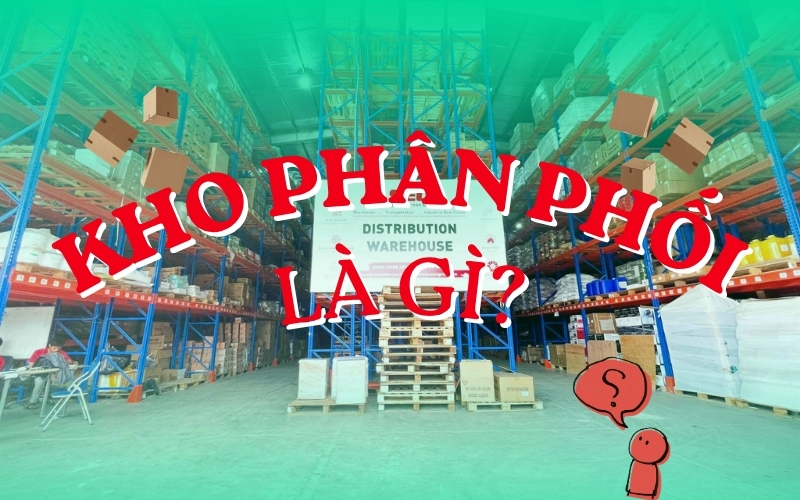
Many people think that distribution warehouses are just places to put goods on shelves and wait for them to be shipped out. This understanding is not wrong, but it still lacks an important part: the distribution warehouse is organized so that goods continue to move quickly, at the right order and at the right receiving point. So What is a distribution warehouse?, how is it different from a regular warehouse and when should businesses invest in this model? The article is below Saigon Express will help you clearly see the role of distribution warehouses in modern logistics operations.
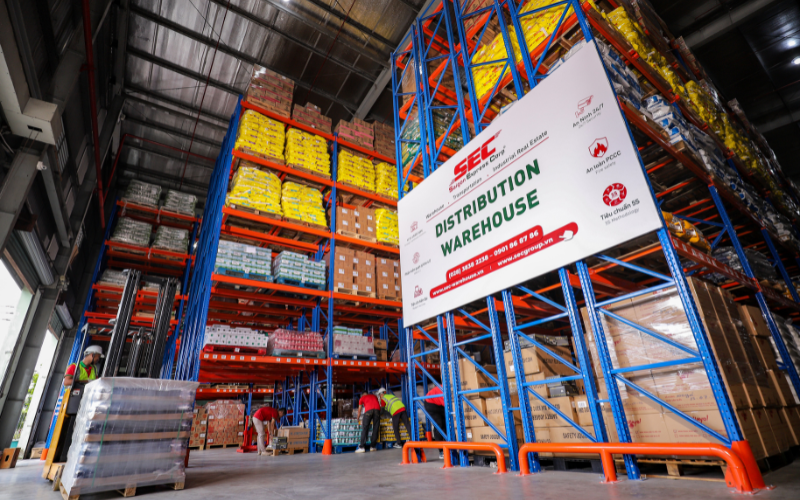
Distribution warehouse, often called distribution warehouse or distribution center in English, is a facility that receives goods from one or more sources, then organizes short-term storage, classification, separation, packaging and dispatching goods to points of sale, agents or end customers.
Simply put, distribution warehouses are not only responsible for "keeping goods". The more important goal is to help goods be processed properly and leave the warehouse on time.
Distribution centers are often considered a form of logistics warehouse with a higher level of operations than conventional storage. In addition to storage, this place can receive goods, count them, put them in place, process orders, collect/split orders, pack, label, prepare documents and hand over to the transport unit.
For example, an omnichannel business can bring goods from a factory or supplier to a distribution warehouse in Ho Chi Minh City. When a customer orders through a website, e-commerce platform or store, the warehouse will receive the order, get the correct product, package and hand over the order to the delivery unit. Goods do not stay in the warehouse for too long but are continuously rotated according to orders.
The role of the distribution warehouse lies in connecting links in the supply chain. It creates an intermediary point between the manufacturer, the supplier, the point of sale and the end buyer.
Businesses do not have to send goods from the factory to each customer for each individual order. Instead, goods are concentrated in distribution warehouses near consumer markets, from there dispatched to areas in need.
This organization helps businesses be more proactive when the number of orders increases or when they need to replenish goods at points of sale.
Unlike warehouses that only prioritize storage, distribution warehouses often handle many stages before goods leave the warehouse: picking goods, checking, dividing orders, collecting orders, packaging, labeling and handing over for transportation.
This is why distribution warehouses are closely linked to order fulfillment operations. However, these two concepts are not always identical, the following section will explain in more detail.
A distribution center is organized to reduce waiting time and speed up turnover. Some models can apply cross-docking: goods from the receiving vehicle go straight to the export area, or only stay for a short time, instead of being put into long-term storage.
This is suitable when businesses need to regularly replenish goods for retail chains or need to process large orders in a short time.
When goods are concentrated through one operating point, businesses can more easily track inventory, order status, import and export quantity and delivery performance. A warehouse management system, commonly known as a WMS, can assist in recording product locations, picking instructions, and updating inventory data.
However, technology only brings value when the process of importing goods, classifying, inventorying and processing orders is clearly designed.
Warehouses and distribution warehouses can both store goods. However, the big difference lies in the operational goals: warehouses prioritize inventory preservation, while distribution warehouses prioritize processing speed and goods rotation.
| Criteria | Warehouse/warehouse | Distribution warehouse/distribution center |
| Main goal | Storage, preservation and inventory management | Storage combined with processing, classification, packaging, and coordination of goods |
| Storage time | Usually longer, depending on inventory cycle | Usually shorter, rotation preferred |
| Core activities | Warehouse entry, storage, inventory, and warehousing | Importing goods, sorting, processing orders, packaging, and coordinating transportation |
| Service oriented | Guaranteed source of goods for production or sales | Meet point of sale, dealer or end customer needs |
| Necessary technology | Can be from basic to advanced level | WMS integration, order processing, and shipping data are often needed |
| Level of complexity | Low to medium | Medium to high, depending on number of orders and number of sales channels |
The industry literature also differentiates the two models based on purpose, value-added services, processing speed, customer focus, and operational complexity. An easy way to remember: warehouse prioritizes keeping goods in the right condition; Priority distribution warehouse brings goods to the right place according to the right need.
.jpg)
Distribution warehouses and fulfillment centers have many similarities because they both process orders and support delivering goods to customers. However, the scope of service may vary.
Distribution warehouses typically serve a variety of receiving points: agents, stores, branches, supermarkets, retailers or end customers. Fulfillment centers often focus more deeply on e-commerce order fulfillment activities: receiving orders, picking, packing, labeling, handing over to shipping units, processing returns and updating order status.
| Criteria | Distribution warehouse | Fulfillment center |
| Subject receiving goods | Point of sale, agent, branch, B2B customer or end customer | Mostly customers place orders online |
| Order | Can be in bales, lots, pallets or individually | Usually small single, multiple single, multi-channel |
| Additional activities | Coordinate replenishment and distribution by region | Processing e-commerce orders, packaging as required, and returning goods |
| Important index | Turnover speed, shipping and inventory accuracy | Order accuracy, processing speed, delivery and return SLA |
| Operational properties | Wider distribution network | More in-depth at the final stage of completing the application |
In fact, a facility can serve as both a distribution warehouse and an integrated fulfillment function. The important thing is not the name, but the flow of goods, the type of order, the level of service to be provided and the operating standards that the business sets.
Each warehouse has its own organization, but a distribution warehouse model usually has the following groups of activities.
Goods from suppliers, factories or central warehouses are received in the inbound area. Staff count, compare documents, check packaging status and record discrepancies if any.
This is an important step because incorrect input data will affect the entire inventory and orders behind.
Once received, the goods are taken to the appropriate storage location. Sorting can be based on frequency of release, size, storage conditions, expiration date or fragility.
Best-selling items should usually be placed in easy-to-access locations to shorten picking time.
.jpg)
When receiving an order, the system or employee creates a pickup order. Goods are picked up according to quantity, product code, batch, expiration date or packaging requirements of each order.
This is the stage that directly determines the accuracy of the order.
After picking, the goods are inspected, packaged, protective materials are inserted when necessary and labeled according to the requirements of the customer or shipping partner.
For products that are perishable or have specific preservation regulations, the packaging process needs to comply with standards appropriate to each industry.
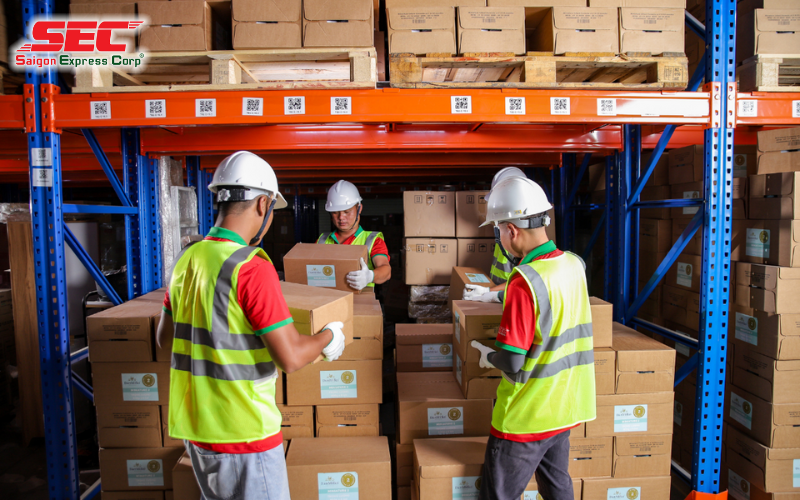
Completed orders are routed, gathered by trip, and handed over to the vehicle fleet or delivery partner. An effective distribution warehouse needs to synchronize information between orders, inventory and shipping status.
Not every business needs to invest in a separate distribution center. For small businesses, low orders and narrow delivery scope, a basic warehouse can serve well.
Businesses should consider the distribution warehouse model when there are one or more of the following signs:
Orders increase and arise from many provinces/cities or many sales channels.
Need to supply regularly to agents, stores, branches or points of sale.
Scattered inventory makes it difficult to control quantity and delivery speed.
Order processing time is long because the warehouse does not have a clear picking, packing and staging process.
Wrong order numbers, missing deliveries, wrong deliveries or returns begin to affect the customer experience.
Businesses want to place orders near consumer markets to optimize the delivery network.
WMS integration, real-time inventory data, and transportation coordination are needed.
The e-logistics market is becoming a driving force for businesses to pay more attention to distribution warehouses. Savills Industrial forecasts that Vietnam's e-commerce market could exceed $29 billion, driving the need for expanded warehouses, modern tracking and faster delivery networks.
Investing in shelves or software is not enough to evaluate effectiveness. Businesses should track metrics that are appropriate to their operating model.
Inventory accuracy: Difference between system data and actual inventory.
Order accuracy: Percentage of orders with correct product, quantity, address and packaging status.
Application processing time: The time from receipt of the application until the application is ready for handover.
On-time delivery rate: The ability to complete the service commitment to the receiving point or customer.
Inventory turnover rate: Reflects the ability to turn inventory into revenue in a period.
Processing costs per order: Includes labor, materials, space, technology and operations involved.
Return/damage rate: Helps identify problems at the picking, packing or shipping stage.
Each business should set index goals based on industry, order type, B2B/B2C sales model and actual capacity, instead of copying a fixed benchmark.
As omnichannel sales grow, inventory data needs to be updated quickly to avoid overselling or misallocation of goods. WMS, barcodes, scanning devices and order connectivity help increase tracking capabilities, but need to be implemented with clear control processes.
The need for quick delivery pushes businesses to consider locating warehouses near consumption areas or organizing a network of multiple distribution points. The goal is not only to shorten the distance, but also to balance warehouse rental costs, operating costs and service quality.
Many distribution warehouses are adding value-added services such as branded packaging, labeling, multi-channel fulfillment, returns management and last-mile delivery support. This reflects the more flexible operating requirements of e-commerce.
The cross-border e-commerce logistics market in Vietnam is estimated to reach 192.06 million USD in 2026 and could increase to 261.03 million USD by 2031. This development puts greater pressure on the ability to process orders, track goods status and coordinate between warehouses and transportation partners.
Answer: A distribution warehouse is a place where goods from suppliers or factories are gathered, then processed and delivered to points of sale, agents or customers. Unlike conventional storage warehouses, distribution warehouses prioritize the speed of goods turnover.
Answer: Warehouse is "warehouse" or "warehouse". This is a facility used to store, preserve and manage goods. Warehouses can handle shipping, but the main focus is often on maintaining a safe, organized inventory.
Answer: In many contexts, “distribution warehouse” and “distribution center” are used synonymously. “Distribution center” often places more emphasis on scale and activities of order processing, sorting, packaging, and transportation coordination.
Answer: Not every warehouse has to implement WMS from the beginning. However, as the number of part numbers, orders, storage areas, or sales channels increases, a WMS can support better control of stock positions, inventory, and order processing.
Answer: Cross-docking is a way of organizing rotation in which goods from the receiving area are quickly transferred to the export area, limiting storage time. This model is suitable when the business has a clear distribution plan, a need for quick turnover and the ability to coordinate well between inputs and outputs.
Distribution warehouses are the link that helps goods not only be stored but also processed, sorted, packaged and dispatched effectively to the receiving point. If the warehouse focuses on preserving inventory, the distribution warehouse focuses on the speed and accuracy of goods flow.
With the development of e-commerce, multi-channel sales and fast delivery requirements, businesses need to re-evaluate the logistics warehouse model based on order volume, customer network, goods characteristics and operating capacity. Saigon Express can support consulting on transportation, distribution and logistics operations solutions suitable to the actual needs of businesses.
AUTHORS

Call center :
0901 868 786
Hotlines Ho Chi Minh :
0901 868 786 - 0939 176 176
Hotlines Ha Noi :
0949 668 875 - 0931 228 875
Hotlines Can Tho :
0901 868 786 - (028) 3776 0700
Hotlines Da Nang :
0901 868 786 - (028) 3776 0700
Hotlines Hai Phong :
0901 868 786 - (028) 3776 0700
24/7 support and Zalo:
0901 868 786




 HO CHI MINH:
Add: 121 Hoang Quoc Viet, Phu Thuan Ward, Ho Chi Minh City
Tel: 0901 86 87 86 - (028) 3776 0700
Email: kinhdoanh@sec-warehouse.vn
HA NOI:
Add: 98 Nguyen Van Giap Street, Cau Dien Ward, Nam Tu Liem District, City. Hanoi
Tel: 0949 668 875 - (024) 7302 2227
Email: info.hanoi@sec-warehouse.vn


DA NANG:
Add: Lot 39, Street 2, Da Nang Industrial Park, An Hai Bac Ward, Son Tra District, City. Danang
Tel: 0901 868 786 - (028) 3776 0700
Email: kinhdoanh@sec-warehouse.vn


.png "Viber 0901868786")