

Price list
Profile
Management
0901 868 786
Price list
Profile
Management
0901 868 786

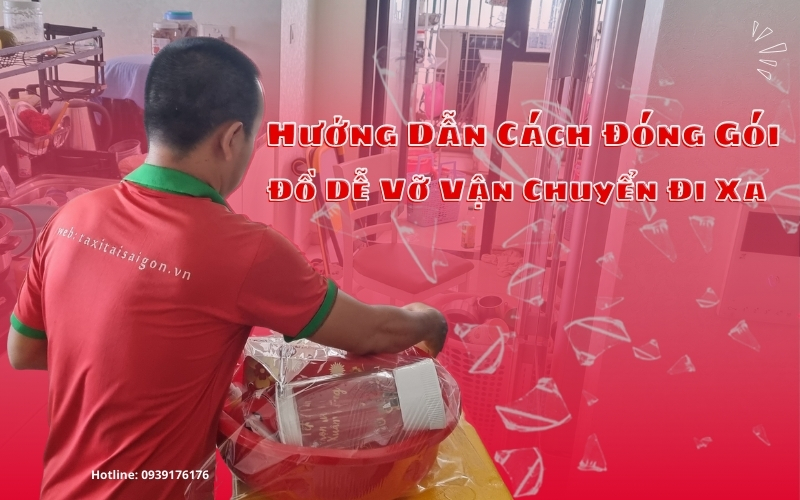
Packaging fragile items consistently represents the most critical phase when executing long-distance transits, specifically for households orchestrating routine residential relocations or dispatching high-value commercial cargo. Within this article, Saigon Express - SEC Group synthesizes empirical expertise amassed across hundreds of minor and major transport operations, empowering readers understanding meticulous handling requirements per fragile category, material selection, and rigorous safety packaging workflows, neutralizing transit hazards throughout journey itineraries.
WHAT CONSTITUTES FRAGILE GOODS? PREVALENT FRAGILE INVENTORY CATEGORIES
Fragile goods comprise possessions featuring structurally delicate compositions or heightened sensitivity toward mechanical shock forces, rendering them highly susceptible to degradation when encountering vibrational resonance and kinetic impacts across long-distance residential relocations. Mastering individual inventory classifications dictates accurate protective material selection alongside correct packaging execution. Prevalent fragile categories encompass:
Glassware, porcelain, and ceramic articles
Fine art canvases, mirrors, and interior decor featuring glazed components
Electronic hardware devices
Liquid-containing bottles and vials
BENEFITS OF STANDARDIZED FRAGILE PACKAGING EXECUTION
Standardized packaging protocols suppress damage exposure while optimizing financial and labor outlays across overall transport operations. Flawless packaging elevates asset security while curtailing auxiliary expenditure. The vast majority of transit breakage incidents originate from flawed packaging execution. Proper packaging yields:
Elevated shock absorption capacities restricting impact-induced fracture.
Enhanced surface defense shielding items against scratching or structural indentation.
Streamlined cargo stacking within trucks, freight containers, or shipping boxes.
Suppressed degradation risk, conserving overall operational expenditure.
Compressed transit schedules and minimized execution errors.
STAGING PACKAGING MATERIALS FOR FRAGILE GOODS
Staging appropriate material assets serves as the decisive variable governing packaging quality. Individual materials fulfill distinct protective functions. Assembling complete material inventories prior to packaging accelerates workflows, simplifies manual execution, and reduces hazard exposure dramatically. Comprehensive preparation establishes secure structural foundations for subsequent transport phases. Mandatory materials for fragile item packaging comprise:
Bubble Wrap: Shock absorption, conforming closely to asset contours.
Kraft Paper or Newsprint: Kinetic impact dissipation and cushioning layer generation.
Information Label Tags: Cargo classification notices.
PE Foam/Sheet Insulation: Container baseline cushioning.
Heavy-Duty Adhesive Tape: Securing joint seams.
Cardboard Partition Inserts: Generating fixed cellular housing compartments.
Leak-Proof Zipper Pouches: Deployed for liquid-bearing bottles.
GRANULAR FRAGILE ITEM PACKAGING WORKFLOWS
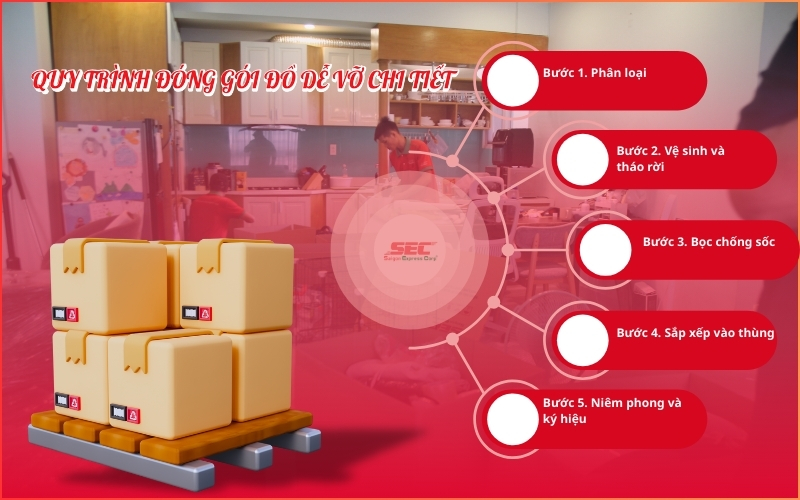
Standardized packaging protocols span multiple sequential phases guaranteeing maximum asset defense prior to long-distance dispatch. Adhering strictly to individual operational actions curtails hazard exposure and withstands vibrational resonance across transits. The standard 5-step workflow governing fragile item packaging spans:
Step 1. Sorting: Segment inventory per material composition and physical dimensions.
Step 2. Sanitation and Component Detachment: Clean surfaces, detach removable handles, lids, or peripheral fittings.
Step 3. Shock-Resistant Wrapping: Deploy paper wrapping alongside bubble wrap securing individual items.
Step 4. Container Stacking: Position heavy articles basally while placing lightweight inventory atop; pack internal voids densely.
Step 5. Sealing and Labeling: Apply adhesive tape, marking prominent "FRAGILE" notices.
Related Insights: How to Safeguard Assets Securely across residential relocations preventing operational errors and asset degradation.
CATEGORY-SPECIFIC PACKAGING PROTOCOLS FOR LONG-DISTANCE TRANSITS
Distinct inventory categories command specialized packaging techniques driven by underlying material properties. Imposing uniform methodologies across all inventory consistently precipitates degradation. Consequently, deploying category-specific packaging protocols remains mandatory:
GLASSWARE, PORCELAIN, AND CERAMIC ARTIFACTS
Glassware, porcelain, and ceramic possessions record peak damage ratios across long-distance transits. Vulnerabilities stem from thin, brittle surface compositions fracturing readily under mechanical compression or persistent vibrational resonance. Safeguarding this category demands prioritizing:
Wrapping individual items initially in paper, followed by 2–3 layers of bubble wrap.
Stemware and cups: position upright, deploying cellular cardboard inserts dividing individual housing units.
Plates: stack vertically within cartons mirroring vinyl record storage arrangements.
Cushion container baselines using 5cm foam pads mitigating impact forces.
Glassware must be housed within compact corrugated boxes restricting kinetic shifting.
FRAGILE ELECTRONIC HARDWARE
Electronic apparatus—such as television sets, computer displays, cameras, acoustic speakers, and media players—exhibit structural fragility alongside extreme sensitivity toward mechanical vibration and impact shocks. Across long-distance transits, vehicular oscillations compromise internal circuitry. Safeguarding fragile electronics mandates observing:
Deploying foam board sheets conforming tightly against peripheral device edges.
Prioritizing original manufacturer packaging whenever retained.
Encapsulating screen surfaces securely via foam sheeting alongside bubble wrap.
Packing internal voids completely preventing hardware displacement.
Maintaining vertical orientations during manual loading, prohibiting horizontal stacking.
Related Insights: Guide to Packing and Transporting IT Equipment tailored for enterprises executing office relocations or technology enthusiasts.
DECORATIVE ARTWORK, PAINTINGS, MIRRORS, AND GLAZED FURNISHINGS
Decorative artifacts, wall-mounted art pieces, and mirrors combine high aesthetic value with extreme sensitivity toward mechanical shock. Minor angular impacts easily fracture entire glass assemblies. Packaging execution targeting this category mandates:
Applying adhesive tape in an "X" matrix across glass surfaces reinforcing structural impact resistance.
Enveloping items within 2 foam layers alongside 1 bubble wrap layer.
Large mirrors: deploy external wooden crating or rigid corrugated reinforcement.
Staging vertical orientations during transit, strictly prohibiting horizontal stacking.
FRAGILE LIQUID-BEARING BOTTLES AND VIALS
Liquid containers—such as vintage wine, fragrances, culinary oils, and sauces—combine fracture risks alongside massive cross-contamination hazards upon leakage. Minor hairline container fractures saturate entire cargo crates. Consequently, this category commands:
Tightening bottle caps securely, reinforcing closures via adhesive tape.
Enclosing individual bottles within zipper pouches neutralizing leakage risks.
Wrapping individual bottles via paper alongside bubble wrap.
Positioning upright within containers, packing internal voids densely utilizing crumpled paper.
Consolidating compact glass bottles utilizing partitioned cellular cardboard trays.
CRITICAL CONSIDERATIONS WHEN TRANSPORTING FRAGILE GOODS
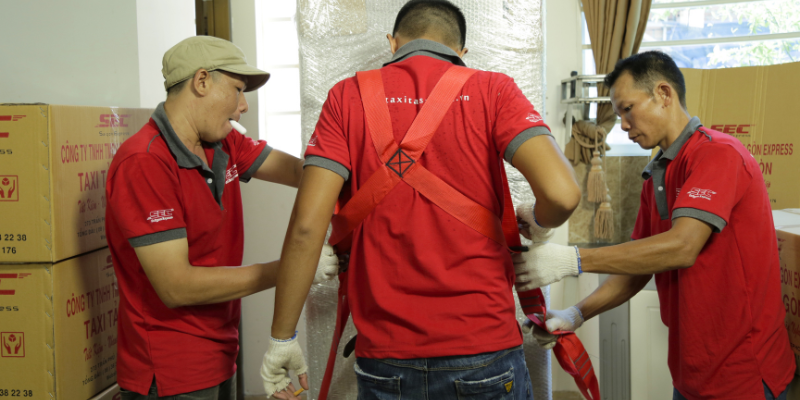
Regardless of packaging excellence, transit operations retain residual hazards originating from vehicle vibration, road infrastructure conditions, and truck stowing configurations. The ensuing advisories guarantee maximum asset defense throughout long-distance transit journeys.
Apply prominent "FRAGILE" visual markings consistently.
Stow fragile inventory within low-vibration vehicle perimeters.
Refrain from placing fragile cartons beneath heavy inventory stacks.
Audit container structural integrity prior to manual loading.
Procure comprehensive transit cargo insurance for high-value possessions.
Executing technical fragile item packaging execution represents the paramount variable handling fragile cargo, securing asset preservation while optimizing expenditure. Mastering individual inventory categories, deploying appropriate material assets, and adhering to standardized workflows curtail transit breakage risks substantially. Should you require professional packaging or transport assistance, Saigon Express remains fully prepared sharing empirical expertise and delivering optimized operational solutions.
AUTHORS

Call center :
0901 868 786
Hotlines Ho Chi Minh :
0901 868 786 - 0939 176 176
Hotlines Ha Noi :
0949 668 875 - 0931 228 875
Hotlines Can Tho :
0901 868 786 - (028) 3776 0700
Hotlines Da Nang :
0901 868 786 - (028) 3776 0700
Hotlines Hai Phong :
0901 868 786 - (028) 3776 0700
24/7 support and Zalo:
0901 868 786





 HO CHI MINH:
Add: 121 Hoang Quoc Viet, Phu Thuan Ward, District 7, City. HCM
Tel: 0901 86 87 86 - (028) 3776 0700
Email: kinhdoanh@sec-warehouse.vn
CAN THO:
Add: National Highway 1A, Hung Thai Ward, Cai Rang District, Can Tho (New Can Tho Bus Station)
Tel: 0901 86 87 86 - (028) 3776 0700
Email: kinhdoanh@sec-warehouse.vn
HA NOI:
Add: 98 Nguyen Van Giap Street, Cau Dien Ward, Nam Tu Liem District, City. Hanoi
Tel: 0949 668 875 - (024) 7302 2227
Email: info.hanoi@sec-warehouse.vn
HAI PHONG:
Add: Vinh Niem Industrial Cluster, Le Chan District, City. Hai Phong
Tel: 0901 86 87 86 - (028) 3776 0700
Email: kinhdoanh@sec-warehouse.vn


DA NANG:
Add: Lot 39, Street 2, Da Nang Industrial Park, An Hai Bac Ward, Son Tra District, City. Danang
Tel: 0901 868 786 - (028) 3776 0700
Email: kinhdoanh@sec-warehouse.vn


.png "Viber 0901868786")