

Price list
Profile
Management
0901 868 786
Price list
Profile
Management
0901 868 786

Transporting a refrigerator ranks among the most damage-prone operations during a residential move. Simply tilting it in the wrong direction or plugging it in too soon after transit can trigger unwarranted risks. Comprehending this anxiety, the turnkey home moving service provider SEC Group - Saigon Express consistently prioritizes equipment safety above all. This article delivers a comprehensive guide and practical expertise regarding how to transport a refrigerator correctly, empowering you to relocate your appliance with absolute confidence.
Executing correct refrigerator transport not only shields the appliance from mechanical shocks but also preserves internal cooling mechanics. When relocated in improper postures, compressor oil can backflow into refrigerant tubing, disabling cooling functionality or generating anomalous noise.
Particularly for side-by-side or high-capacity units featuring intricate internal architectures, improper transport readily induces structural frame warping, door rim cracking, or gas leaks. This underscores why professional refrigerator moving services strictly enforce rigorous workflows, ensuring appliances travel in upright postures and anchor securely. Investing time to understand safety protocols remains the optimal strategy to safeguard your assets.
Thorough preparation prior to transit is mandatory to guarantee appliances remain immaculate, desiccated, and primed for shifting:
Disconnect Power and Unplug Prior to Transit: Allows compressor oil to settle into stable baseline positions, preventing spillage during movement.
Extract All Foodstuffs, Trays, Freezer Bins, and Shelves: Lightens appliance weight while mitigating dropping or impact hazards during transit.
Detach Internal Components: Remove glass shelves, trays, and storage compartments—components vulnerable to breakage or shifting impacts during movement.
Secure Refrigerator Doors: Deploy specialized packing tape or strapping belts to anchor doors firmly, preventing accidental opening during transit.
Plug refrigerators back in post-transit following a minimum 2–3 hour stabilization window for oil to return to the block—a mandatory principle frequently overlooked.

Sanitizing and wiping down refrigerators prior to transport
Refrigerator packaging demands meticulous execution to shield units against damage induced by horizontal transport missteps. The following measures establish solid foundations for secure transit journeys.
This critical phase minimizes scratching and denting during collisions. Encase the entire body thoroughly, particularly corners, handles, and door frames. Utilize bubble wrap or PE film; bubble wrap absorbs shock and dampens impact forces. Subsequently, wrap exterior layers with PE film or heavy-duty packaging tape to anchor firmly, preventing displacement during lifting and transport.
Following bubble wrapping, secure appropriately sized, well-fitting large carton boxes. Cartons provide a rigid outer shell resisting external pressures, especially when transporting refrigerators alongside diverse cargo loads on trucks. Lacking oversized boxes, flat corrugated cardboard panels can shield all four sides to stabilize structures and prevent exterior paint scratching.
Secure cargo lashing straps or soft webbing around the appliance body. Avoid excessive tension to prevent exterior denting. Strapping prevents cardboard and bubble wrap layers from shifting while establishing stable leverage for movers to maneuver units effortlessly using hand trucks.
Warning labels prompt drivers and handlers to exercise heightened care during transit, particularly when navigating staircases or uneven terrain. Affix "Fragile" notices and, most importantly, "This Way Up" indicators, providing clear operational signals regarding safe posture requirements.
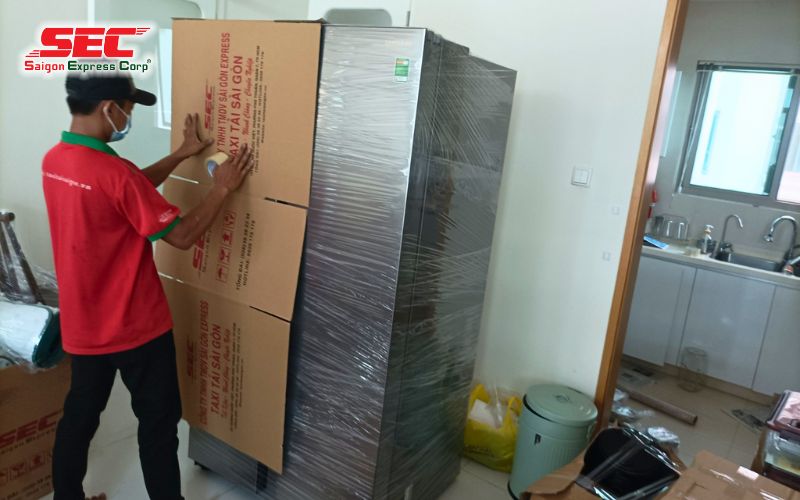
Saigon Express executes meticulous protective wrapping during refrigerator transit
You might be interested in: Turnkey Home Relocation Services in HCMC conserving valuable time and mitigating asset damage risks
Safe refrigerator transit workflows transcend meticulous packaging, encompassing sequential actions executed throughout movement. The following methodologies safeguard against severe structural failures:
Refrigerators must remain upright at all times, avoiding tilts exceeding 45 degrees. Horizontal positioning permits oil and gas migration into tubing, triggering clogs or compressor failure. In unavoidable contingencies (such as narrow doorways), slight tilting is permissible provided units rest upright for a minimum 3–4 hours prior to powering on. Never transport refrigerators horizontally due to high probabilities of oil flooding cooling loops, destroying compressors immediately upon startup.
Refrigerators inherently feature heavy, bulky dimensions, mandating coordinated teamwork between at least two handlers. Balanced weight distribution prevents tilting, tipping, and physical injury risks. Professional moving services consistently deploy supporting apparatus and trained personnel to guarantee smooth lifting operations.
Loaded onto trucks, pickup beds, or even motorcycles (for compact units), refrigerators require secure anchoring against vehicle sidewalls via lashing straps or specialized belts. Position units flush against vehicle partitions, utilizing moving blankets or foam padding to fill gaps, preventing shifting or impacts against other cargo. Superior anchoring minimizes vibrational turbulence—the primary catalyst for electronic component failures.
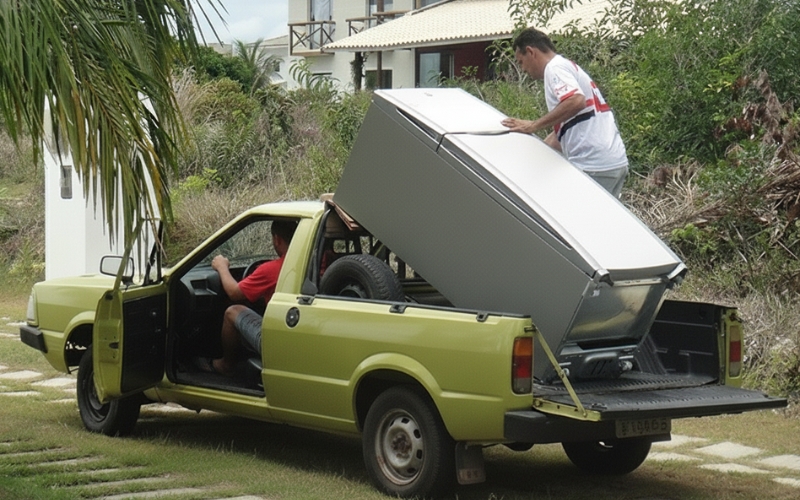
Securing refrigerators safely on transport vehicles using lashing straps
Drivers should preserve stable velocities, avoiding abrupt braking or sharp cornering. Long-distance transits warrant interim rest stops to inspect strap tension and vertical alignment. Severe jolts risk displacing refrigerant loops or compressors, degrading cooling performance.
Avoid excessive tilting or horizontal positioning across prolonged durations. Do not power on refrigerators immediately post-transit; await a 2–3 hour stabilization window. Upon arrival, audit operational noise, vibrational stability, and cooling performance following 1–2 hours of test running. Should units fail to cool or generate abnormal noises, unplug and inspect installation parameters—oil may remain unsettled within compressors. Position units away from walls or heat sources (such as gas cooktops), maintaining minimum 10cm ventilation clearances for heat dissipation.
COMPARISON: SELF-MANAGED VERSUS PROFESSIONAL MOVING SERVICES
|
Criteria |
Self-Managed Transit |
Professional Services (SEC Group) |
|
Tariffs |
Economical but harbors hidden risks |
Optimized, turnkey, transparent |
|
Safety Levels |
Elevated risk exposure, particularly lacking experience and supporting apparatus (hand trucks, straps). Prone to errors such as horizontal transport. |
Absolute security, benchmark workflows, asset insurance coverage. Strictly enforces upright postures and correct transport methods. |
|
Supporting Tools |
Deficient in hand trucks, lashing straps, etc. |
Comprehensive, specialized cooling equipment handling tools |
|
Time Efficiency |
Consumes extensive personal time packing, renting vehicles, and transiting. |
Rapid, efficient, capable of handling multiple asset categories concurrently. |
Refrigerator transport demands meticulousness, patience, and strict compliance with technical regulations. Lacking prior experience or seeking guaranteed asset protection, SEC Group stands ready to assist with rapid, professional turnkey solutions. Connect instantly for consultations and tailored quotations matching your residential moving requirements.
AUTHORS

Call center :
0901 868 786
Hotlines Ho Chi Minh :
0901 868 786 - 0939 176 176
Hotlines Ha Noi :
0949 668 875 - 0931 228 875
Hotlines Can Tho :
0901 868 786 - (028) 3776 0700
Hotlines Da Nang :
0901 868 786 - (028) 3776 0700
Hotlines Hai Phong :
0901 868 786 - (028) 3776 0700
24/7 support and Zalo:
0901 868 786





 HO CHI MINH:
Add: 121 Hoang Quoc Viet, Phu Thuan Ward, District 7, City. HCM
Tel: 0901 86 87 86 - (028) 3776 0700
Email: kinhdoanh@sec-warehouse.vn
CAN THO:
Add: National Highway 1A, Hung Thai Ward, Cai Rang District, Can Tho (New Can Tho Bus Station)
Tel: 0901 86 87 86 - (028) 3776 0700
Email: kinhdoanh@sec-warehouse.vn
HA NOI:
Add: 98 Nguyen Van Giap Street, Cau Dien Ward, Nam Tu Liem District, City. Hanoi
Tel: 0949 668 875 - (024) 7302 2227
Email: info.hanoi@sec-warehouse.vn
HAI PHONG:
Add: Vinh Niem Industrial Cluster, Le Chan District, City. Hai Phong
Tel: 0901 86 87 86 - (028) 3776 0700
Email: kinhdoanh@sec-warehouse.vn


DA NANG:
Add: Lot 39, Street 2, Da Nang Industrial Park, An Hai Bac Ward, Son Tra District, City. Danang
Tel: 0901 868 786 - (028) 3776 0700
Email: kinhdoanh@sec-warehouse.vn


.png "Viber 0901868786")